

Map the system
Identify the aircraft, sensors, control link, operator, power, software and support chain. Draw the dependencies before choosing parts.
SHOW YOUR WORK · A labeled system map with two failure points.
Loading page
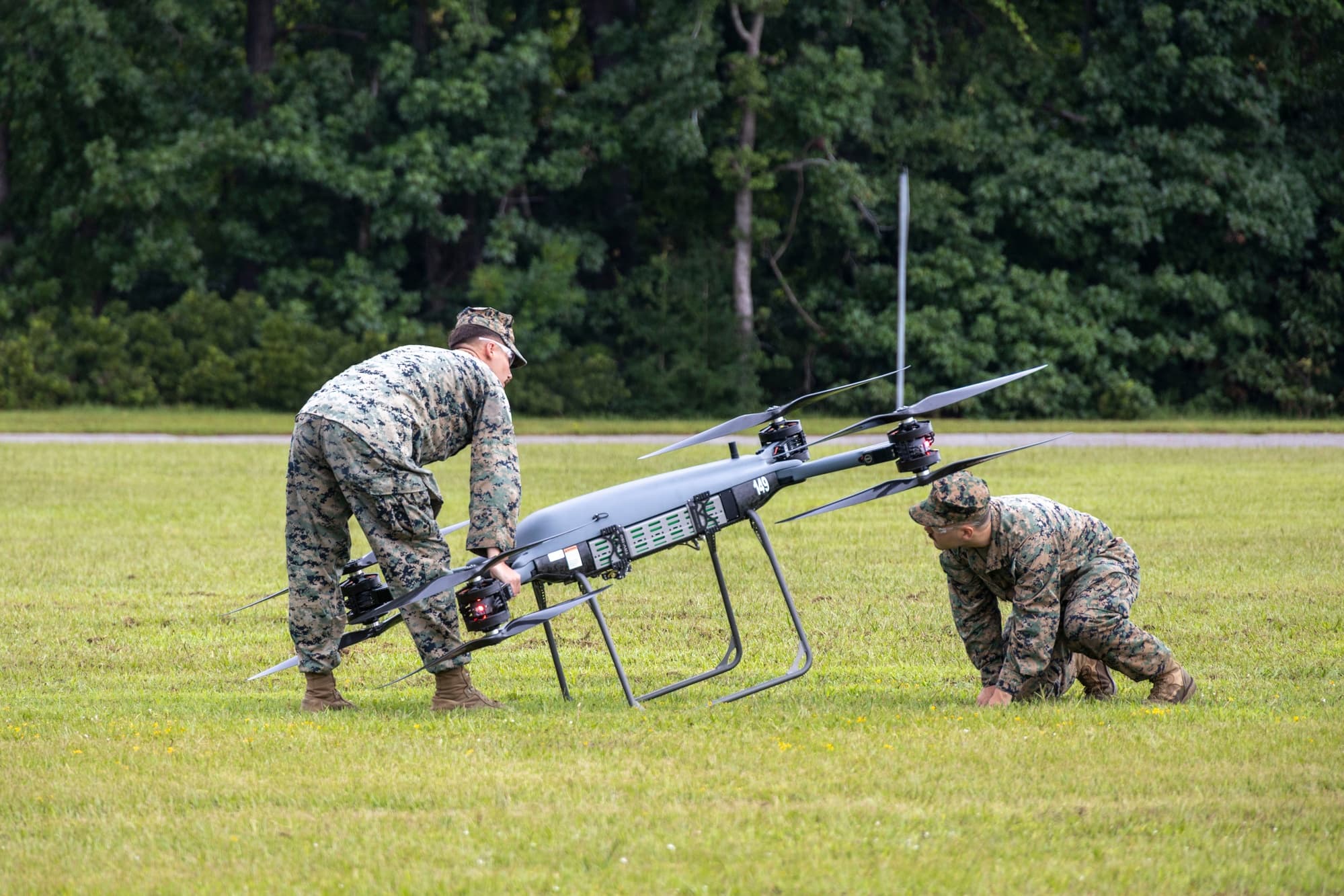
ENGINEERING / AUTONOMY / MODERN SERVICE
Learn how unmanned systems are designed, tested and sustained. Examine public accounts of their use in today’s military, then apply the lessons to safe, non-weaponized engineering challenges.
Photo: Lance Cpl. Isabella Ramos / U.S. Marine Corps / DVIDS. Training image; no AHH affiliation. ↗THE QUESTION
Power, sensing, software, operators, maintenance and evidence all affect the result. This preview connects engineering fundamentals to the wider decisions leaders face when adopting autonomy.
PROPOSED LEARNING PATH
Each step ends with something you can show and explain. Full lessons, instructor review and enrollment are still in development.
Identify the aircraft, sensors, control link, operator, power, software and support chain. Draw the dependencies before choosing parts.
SHOW YOUR WORK · A labeled system map with two failure points.Translate a search, inspection or medical delivery need into constraints: endurance, environment, reliability, repairability and cost.
SHOW YOUR WORK · A one-page requirements and tradeoff brief.Compare fabrication options and make a test plan for a non-weaponized prototype. Record inspection results and revisions.
SHOW YOUR WORK · A prototype review and test log.Separate remote control, assisted flight and autonomous decisions. Define where a human must review or intervene.
SHOW YOUR WORK · A human-oversight and fallback diagram.Study publicly documented reconnaissance, logistics and medical-resupply roles, while accounting for uncertainty and incomplete footage.
SHOW YOUR WORK · A sourced case analysis, with limits of the evidence.Assess training, supply, cybersecurity, maintenance and accountability alongside the platform itself.
SHOW YOUR WORK · A readiness and risk review.2026 FIELD BRIEF · UPDATED SEPTEMBER 2026
Public reporting points to four connected challenges. The Academy will turn each one into a short source-led lesson with a practical decision and an evidence check.
Compare reconnaissance, logistics, medical delivery and human oversight.
Ask what machines can assist with and what people must still verify.
Test whether a design can be inspected, supplied and maintained.
Explore publicly documented sensor integration and protective training.
Unmanned aircraft cross the scene as a shipboard defensive system responds. This is an abstract visual illustration, not a simulation of actual equipment or tactics.
Stylized artwork. Explore the sourced field brief and exercises below to distinguish published evidence from visual storytelling.
TRY A 30-SECOND DECISION
Your team is prototyping a non-weaponized medical-supply drone. The link may fail during a supervised test. Choose the first engineering decision you would defend.
Pick the question you would ask before claiming the system changes the future force.
Select a question to check your reasoning.
Preview exercises only. No score or progress is saved.
FIELD FOOTAGE
These external U.S. military videos show training and logistics use. Their appearance here does not imply endorsement or an AHH partnership.
Marines practice aircraft familiarization and mock resupply at Camp Lejeune.
Video: Cpl. Meshaq Hylton / U.S. Marine Corps / DVIDS ↗Army personnel explain why hands-on unmanned aircraft training matters.
Video: Sgt. 1st Class Tanisha Karn / U.S. Army / DVIDS ↗ENGINEERING LAB / FOUR SHORT LESSONS
Read one concept, complete one small task, then explain your result. These are original Academy practice prompts informed by the linked external materials; they are not copies of those organizations’ lessons or affiliated training.
Trace a civilian FPV aircraft from frame and propellers through motors, speed controller, flight controller, receiver and camera.
Sketch the signal and power paths. Label what each part measures, commands or supplies.
A sensor measures a state, a controller compares it with a target, and an actuator changes the system. Observe why testing and fault detection matter.
Diagram a desktop fan with a temperature sensor, motor controller and safe shutoff condition.
Translate an input, decision and output into a simple industrial automation scenario, with a manual stop and a test case.
Write a three-step rule for a conveyor that stops when a guard opens. Test the normal and fault cases on paper.
Connect engineering, instrumentation and repeatable tests to the workforce skills used in test and training environments.
Make a test card: objective, measurement, pass criterion and what to record if it fails.
All exercises use ordinary civilian or tabletop examples. Check current manufacturer instructions and qualified supervision before working with powered hardware.
NEXT SKILLS / LEARN BY DOING
Explore skills relevant to modern service and civilian work. These are proposed Academy exercises, not accredited courses or credentials. Start with open data and a clear, non-operational question.
Compare what a model detects with what a person can verify. Record uncertainty and false positives.
TRY IT · Review a public, civilian image set and write a model limitation note.Clean observations, visualize trends and ask which assumptions change the conclusion.
TRY IT · Build a simple chart with an uncertainty statement.Learn coordinates, geodesy, surveying, spatial statistics and how map data is maintained.
TRY IT · Map a local accessibility or environmental question.Compare imagery sources, resolution and dates before drawing conclusions.
TRY IT · Annotate a publicly available land-use change with source dates.Read water-depth data as measured evidence, including coverage and safety limits.
TRY IT · Explain what an open coastal survey does and does not show.Test an explanation against alternatives and write down what evidence would change your mind.
TRY IT · Make a source-and-assumptions checklist.The skill areas include artificial intelligence, machine learning, computer vision, data modeling, analytics and visualization, geomatics and geodesy, geospatial data management, GIS, remote sensing, bathymetry, spatial statistics and structured analytic techniques.
KEEP EXPLORING
These links lead away from Aim High Hero. Check each institution’s current requirements and course access before applying.
Explore digital forensics, cyber training and defense support. An external government resource.
ELIGIBILITY-BASED TRAININGReview its published course offerings and eligibility; access is not open enrollment through Aim High Hero.
REGIONAL CONTEXTA January 2026 official information sheet; the document may be unavailable from some networks.
HISTORICAL CURRICULUM / FY2022See how an earlier defense intelligence catalog grouped analytic tradecraft, data analytics, open-source research and geospatial topics. It is from FY2022; do not use it for current enrollment or availability.
RESEARCH PRIORITIESDiscuss human factors, data, small uncrewed aircraft and protective systems at a public, non-operational level. This is a research-priority document, not a course.
COURSE CATALOGExplore professional education topics; individual courses can require affiliation, nomination or clearance.
FEDERAL CAREERSFind official guidance on federal careers and veteran employment resources.
For more research, browse the SOCoE library’s database directory. For a civilian education comparison, see Northeastern’s military education flyer on analytics, IT, manufacturing and management. Verify any tuition or eligibility claim directly with the institution. The DC3 FY26 course catalog may be access restricted.
READ THE EVIDENCE
Research, analysis and public military reporting. West Point MWI articles express their authors’ views, not official U.S. military positions.
Start with the research collection on AI and unmanned systems.
Open source ↗HUMAN JUDGMENTUse this to debate which tasks require trained human judgment.
Open source ↗DESIGN & SUSTAINMENTExplore iteration, quality control and the limits of field production.
Open source ↗CRITICAL ANALYSISCompare compelling battlefield footage with the larger support system.
Open source ↗STRATEGIC CONTEXT · CSISPut unmanned systems alongside industry, people and long conflicts.
Open source ↗FORESIGHT · U.S. INTELLIGENCECompare long-range scenarios with what can be verified today.
Open source ↗PUBLIC TEST · U.S. ARMYStudy a public example of connecting sensors, people and defensive systems.
Open source ↗INNOVATION · CSISExamine why testing and acquisition pace matter to leaders.
Open source ↗HISTORY & SOCIETYRead a broader view of the institution and the people serving in it.
Open source ↗ADAPTATION · CARNEGIECompare rapid adaptation with slower technology cycles; treat the argument as analysis.
Open source ↗TRAINING · U.S. DEFENSESee a recent public example of training for unmanned aircraft threats.
Open source ↗Continue the research: MWI’s SIGAR archive for oversight, Collins Aerospace and Pratt & Whitney for industry perspectives on sustainment and aerospace, and the RealClearDefense video archive for additional commentary. For a product and engineering perspective, review Leonardo DRS technology and the Mercury Systems content library. Compare vendor claims with independent research. These external sources are not Academy partners. Aim High Hero is independent of West Point, these companies and the U.S. Department of Defense.